
For workforce, energy & community program sponsors
Contractor Training
& Field Challenges
Learn on real homes. Build the skills to turn home-energy findings into useful projects and business opportunities.
Sponsor a practical learning pilot for contractors, inspectors, assessors, and home-energy advisors. Participants gather Home Facts. Green Home Club reviews the evidence, explains corrections, and teaches participants how to develop a useful plan and proposal. Technical specialists provide targeted testing and judgment when the home calls for it.
Pilot opportunities · Scope and launch dates agreed with sponsors · Home Facts Catcher in development
The teaching model
Let them gather the real facts. We'll review and teach.
Build on people who already work in homes. A trained contractor or coach can lead the first walkthrough, gather useful evidence, and record uncertainty. Office review then becomes a teaching session: what did the record establish, what remains unknown, and what should happen next?
Start with what the professional can establish
Use the Home Facts Catcher and GHP prompts to collect observations, photos, and notes. Prepare a preliminary Home Snapshot and workscope. Record where help was useful and where confidence ran out.
Explain the reasoning behind the revisions
We review the record, organize the evidence, identify gaps, and help develop the plan and proposal. Participants learn why a finding changes, how to explain it to a homeowner, and which questions need a specialist.
Bring advanced assessment to the right questions
Technical review can confirm or correct assumptions, identify missed conditions, and determine where an on-site diagnostic visit is needed. Participants compare their preliminary work with the findings that follow.
Every home becomes a learning record: preserve the initial Home Snapshot and preliminary scope, document review findings, and show the revised plan with the reasons for each change.
Why contractors participate
Useful tools. Expert feedback. Skills they can take to the next job.
Document a home with confidence
Practice a repeatable walkthrough using selections, photos, and typed or dictated notes. Learn to distinguish observed conditions from assumptions and verification needs.
Turn findings into a scope
Use Green Home Predictor and coaching to organize priorities, coordinate trades, and prepare a homeowner explanation and draft proposal.
Develop a service they can offer
Practice estimating effort, defining deliverables, explaining value, and making a professional handoff. Build a reviewed example of their work.
Sponsors can strengthen participation by funding coaching, tool access, assessment costs, and agreed stipends or prizes. Each pilot defines its participant offer before recruitment.
The field tool
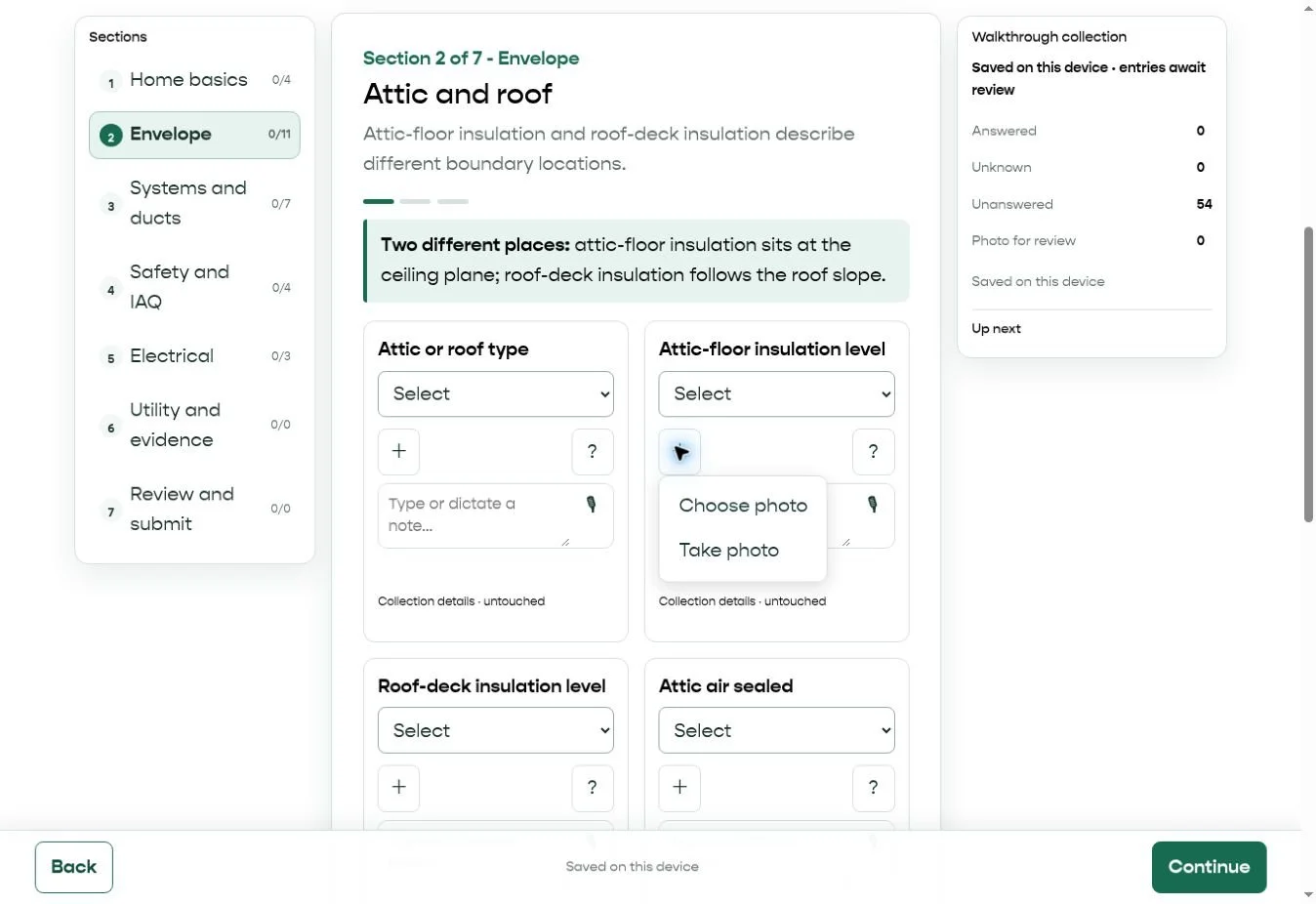
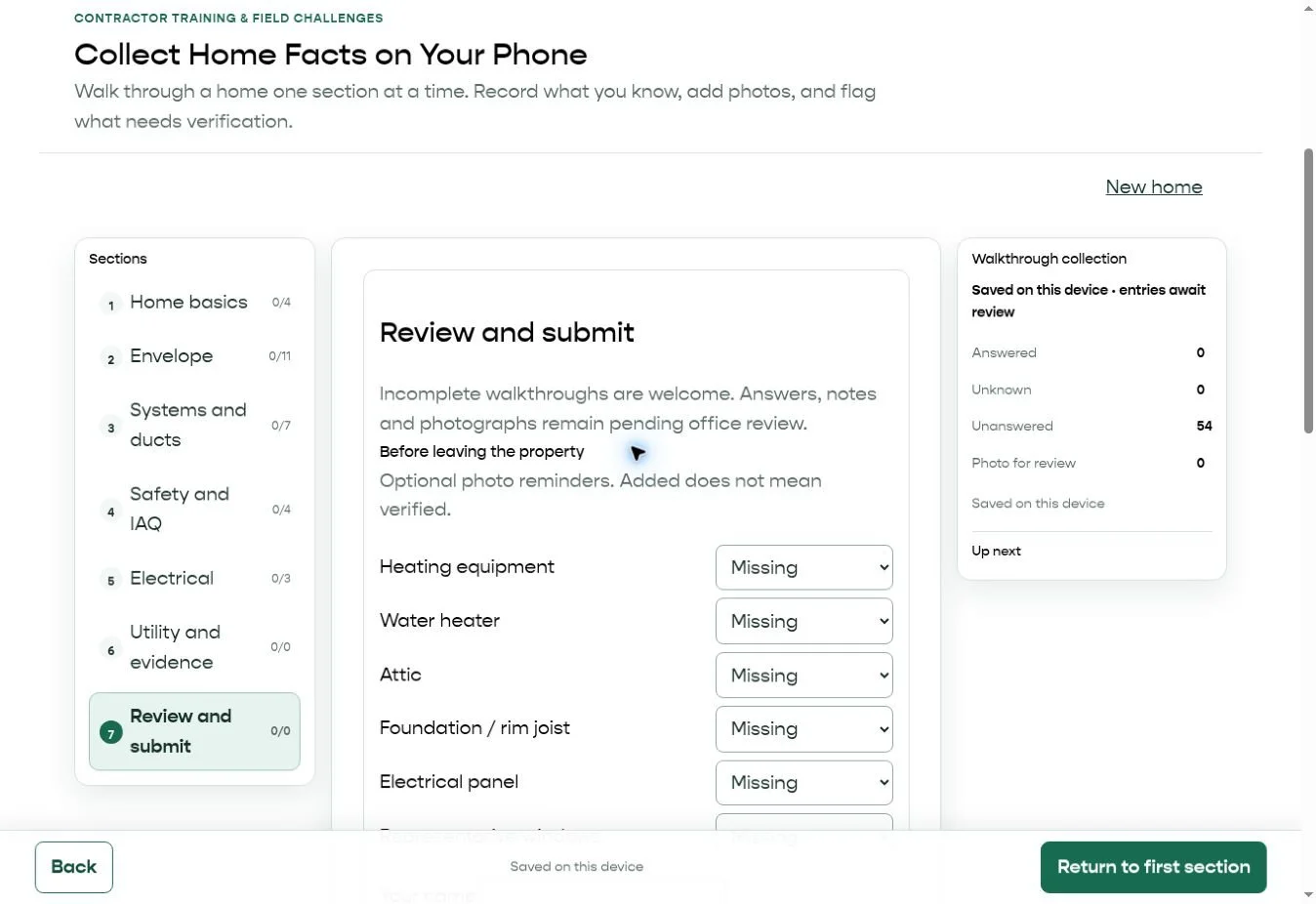
Collect Home Facts on your phone.
Walk through a home one section at a time. Record what you know and flag what needs verification.
- Select the condition you can identify.
- Photograph equipment, assemblies, and details for review.
- Type or dictate a note to explain what the picture cannot.
The development preview shows the collection interface. Photo interpretation and delivery to the office are being developed; the pilot will define a working transfer and review process before participants submit homes.
See the walkthrough review preview
An educational contest
A field challenge that rewards learning.
Participants work through an assigned home case, receive feedback, and improve their own work. The proposed challenge follows four steps:
Prepare & gather
A field lead documents the home with permission. Participants complete their assigned collection or case-review work, noting assumptions, uncertainties, and questions held for verification.
Review & teach
Green Home Club reviews the home record and uses it for coached case sessions. Participants practice turning the evidence into priorities, a preliminary scope, and a homeowner explanation.
Test & compare
The Green Home Club trainer reviews the technical questions and conducts targeted diagnostics on selected homes. Compare what the first visit established with what later review or testing changed.
Revise & explain
Each participant submits an updated scope or proposal and explains the changes. Final judging considers accuracy, documentation, appropriate referrals, and learning demonstrated after feedback.
The contest score measures the participant’s work. An official Home Energy Score rates the home and requires its own qualified assessment process. Challenge rules, awards, assessment arrangements, and eligibility are set before launch.
A proposed contractor training pilot
10 Homes, 100 Pros.
The goal is to help 100 residential professionals learn to turn a home walkthrough into a useful greener home improvement plan. Ten real homes supply the photos, observations, and technical findings used in the training.
How ten homes serve 100 people: Field leads collect information during scheduled home visits. All participants learn from those home records through guided case sessions and individual assignments.
Document the ten homes
Participating contractors or Green Home Club field leads use the Home Facts Catcher to record photos, observations, homeowner priorities, and questions they cannot confidently answer.
Learn from a trainer’s review
Green Home Club trainers review each record, explain corrections, and show how the findings shape a plan and proposal. Qualified specialists provide on-site testing when a home’s unanswered questions require it.
Each professional does the work
Each of the 100 participants works on assigned home cases: identify priorities, prepare a preliminary scope, receive feedback, and revise a homeowner explanation or proposal.
What participants learn: what they can establish during a first visit, when to ask for specialist help, and how to turn reviewed findings into a proposal they can explain to a homeowner.
How far can a trained field professional take a home using GHP, and when does the workflow correctly signal the need for advanced testing or specialist judgment?
What the pilot will document
- First-visit usefulness: what an informed non-auditor can collect, which prompts help, and where uncertainty remains.
- Technical accuracy: corrected assumptions, missed conditions, appropriate verification flags, and changes after diagnostics.
- Learning and business readiness: each participant’s revisions and ability to explain the project, prepare a proposal, and define a service.
- Delivery effort: field time, office review and teaching time, specialist time, repeat visits, and reasons for escalation.
Compare the initial record, reviewed findings, and revised plan. The pilot tests where the approach works and what support it needs; results will guide the next phase.
Training & delivery
Build on the skills people already bring.
The pilot can include residential contractors, home inspectors, energy assessors, and advisors, with assignments matched to their experience and qualifications. In the proposed pilot, the Green Home Club trainer serves as the technical field specialist: reviewing records, resolving advanced questions, and visiting selected homes. Routine first visits are led by participating professionals or the Green Home Club field lead.
Applied training through Green Home Club
Home Facts collection, whole-home planning, customer communication, proposal preparation, trade coordination, and the practical work of developing an independent service.
Qualified training & assessment partners
Where a pilot includes official Home Energy Score training, arrange that pathway through GreenHome Institute or another qualified provider. Credential requirements and field verification are specified separately.
A clear purpose for each sponsor
Sponsor the outcome your program needs.
Contractor training and home energy labeling can be sponsored separately or combined. Each agreement defines its audience, activities, budget, deliverables, and reporting.
| Program focus | What the sponsor supports | What we track |
|---|---|---|
| Contractor Training & Field Challenges | Applied learning, supervised practice, coaching, and business readiness. | Participation and completion; documentation quality; revisions after feedback; proposal readiness; service-development milestones. |
| Home Energy Labeling | Qualified home assessments, understandable energy information, and homeowner next steps. | Completed assessments and reports; homeowner understanding; referrals and documented follow-through. |
Count participating professionals separately from the home cases. Track individual assignments and demonstrated learning alongside attendance. Reporting distinguishes training achievements, assessed homes, and completed improvements; measures and targets are agreed before the pilot begins.
Start with a focused pilot
Let’s shape a challenge for your program.
Tell us who you want to train, the skills or business outcomes you need, and the support available for participating homes. We can define a practical first phase together.
For sponsor inquiries or contractor interest, include “Contractor Training & Field Challenges” in your message.